Think of a rental payment receipt template as a standardized form you use to document a rent payment. It's a simple tool that helps landlords and tenants keep a formal record of every transaction. By providing a consistent format, it captures all the critical details—the date, amount, rental period, and property address—so both parties have clear proof of payment. It's hands-down the easiest way to prevent headaches and maintain professional financial records.
Why a Professional Rental Receipt Is Not Optional
Let’s get real for a minute. A scribbled note on a piece of paper or a quick "got it, thanks" email just doesn't cut it for rent payments anymore. In the modern rental world, a professional, detailed receipt is your best line of defense against arguments over payment dates, amounts, or late fees.
This is about more than just good paperwork; it’s about building credibility and trust right from the start. When you use a consistent rental payment receipt template, it immediately shows you mean business.

Protection for Landlords and Tenants
From a landlord's perspective, a clear receipt is undeniable proof of income and payment history, which is absolutely essential for managing your finances. Picture this: a tenant insists they paid you in cash, but you know they didn't. Your detailed receipt log is the hard evidence you need.
For tenants, that very same receipt is their safety net. It protects them from false eviction claims based on non-payment and acts as vital proof when it’s time to get a security deposit back. A solid track record of on-time payment receipts can even help someone build a positive rental history for their next apartment.
A receipt is proof of exactly what was paid for. If a dispute over cleaning fees or other charges ever pops up, a signed and delivered receipt can serve as a secondary record of the agreed-upon charges.
The Foundation of Good Record-Keeping
Professional rental receipts do more than just track payments. They are fundamental for financial management and legal compliance, especially come tax time. For any property owner, knowing how to organize receipts for taxes is a crucial skill. Good documentation makes tracking income and expenses much simpler, leading to a smoother, less error-prone tax filing process.
Using a professional receipt shows you're organized and transparent, which helps foster a much better landlord-tenant relationship. Here’s a quick rundown of the key benefits:
- Dispute Resolution: It provides a clear, factual record that can instantly clear up misunderstandings about payment dates or amounts.
- Legal Compliance: Many places have laws requiring landlords to provide a receipt, particularly for cash payments.
- Financial Clarity: It helps both parties track payments accurately, which is a big help for budgeting and tax prep.
In the end, a simple template ensures every important detail gets captured correctly, every single time. It turns a routine task into a powerful tool for protection and professionalism.
What Makes a Great Rental Receipt?
A good rental receipt does more than just say "thanks for the cash." It’s a complete, undeniable record of a transaction. When you're building a rental payment receipt template, the goal isn't just to list what was paid, but to create a document that protects everyone involved.
Every piece of information has a job, from identifying the people and the property to breaking down the exact payment details. If you leave key parts out, the receipt becomes vague and a lot less helpful if a dispute ever comes up.
Consider this: the on-time rental payment rate for independently operated units recently hit 83.2%, but that was after 25 straight months of declines. That kind of back-and-forth shows just how important it is to have rock-solid documentation that leaves no room for interpretation. You can dig into the data on independent landlord rental performance from Chandan Economics.
The Absolute Must-Haves
Think of these elements as the foundation of your receipt. They're the non-negotiable details that make the document legally and practically sound. Without them, you're opening the door to confusion and potential headaches down the line.
Here’s what every single rental receipt needs:
- Landlord and Tenant Information: Full, legal names for you (or your property management company) and every tenant listed on the lease.
- Property Address: The full address of the rental unit, right down to the apartment number.
- Payment Date: The exact date you received the money. Not when they sent it, but when it was in your hands.
- Amount Paid: The total dollar amount received, spelled out clearly.
- Rental Period: The specific month and year the payment is for (e.g., "Rent for October 2025").
A flawless receipt is your first line of defense. It eliminates ambiguity and provides a clear, shared understanding of the transaction, which is the cornerstone of a positive landlord-tenant relationship.
Smart Additions for Extra Clarity
Once you have the basics covered, a few extra details can take your receipt from adequate to excellent. These aren't always required by law, but they add a layer of professionalism and can stop tenant questions before they even start.
I always recommend adding these to your template:
- Payment Method: Was it cash, a check (if so, note the check number), an ACH transfer, or a credit card? This creates a better paper trail.
- Remaining Balance: If it was a partial payment, clearly state how much is still owed. This avoids any "he said, she said" about the remaining debt.
- Itemized Breakdown: If the payment covered more than just rent—like utilities, a pet fee, or late charges—list each item and its cost separately.
- Unique Receipt Number: Assigning a sequential number to each receipt makes organizing your records a breeze and referencing a specific payment simple.
To make it even clearer, let's look at what's truly essential versus what's a professional best practice.
Essential vs. Optional Fields for Your Rental Receipt
This table breaks down the components that make a rental receipt truly comprehensive, separating the legally necessary information from the details that just add clarity and professionalism.
| Component | Why It Matters | Importance |
|---|---|---|
| Full Names & Address | Legally identifies the parties and property involved. | Must-Have |
| Payment Date & Amount | Provides indisputable proof of when and how much was paid. | Must-Have |
| Rental Period | Prevents confusion over which month's rent is covered. | Must-Have |
| Payment Method | Creates a clearer audit trail for financial records. | Good-to-Have |
| Remaining Balance | Documents partial payments and prevents disputes over debt. | Good-to-Have |
Ultimately, the more detail you include, the less room there is for miscommunication. A well-crafted receipt template saves you time and protects your business in the long run.
Building Your Branded Template in Under 5 Minutes
Alright, let's get practical. Creating a professional rental receipt doesn't have to be a chore, and you definitely don’t need any fancy design software. With the right setup, you can have a branded, reusable template ready to go in just a few minutes.
Think of this as creating a master copy. You build it once, and it saves you a ton of time and helps you avoid mistakes every single month. It's less about filling out a form and more about crafting a document that works for you.
First Steps: Adding Your Brand Identity
Your brand is your professional reputation, and a good receipt should reflect that. The very first thing to do is add your business logo. It's a small touch, but it instantly makes the document look official and trustworthy. Most receipt generators have a simple upload button for this.
Next, get your core business details in there. This is the information that should be on every receipt you issue.
- Your Name or Company Name: Make sure this is the same name that appears on the lease agreement. Consistency is key.
- Business Address: Your office address or a professional P.O. Box is perfect.
- Contact Information: Always include a phone number and a professional email address so tenants know how to reach you.
Once you save these details in your template, they’ll show up automatically on every new receipt. No more typing the same info over and over.
Customizing Fields for Your Properties
Let's face it, no two rental situations are exactly the same. Your receipt template needs to be flexible enough to handle that. This is where a good template really shines—it lets you add, remove, or rename line items to match what you're actually charging for.
For instance, you'll often need to document charges that go beyond the base rent. A customizable template makes it easy to add specific lines for things like:
- Monthly Pet Fee: Clearly separates this from the rent itself.
- Prorated Utilities: Perfect for showing a tenant's share of a water or trash bill.
- Parking Space Fee: Itemizes the cost for an extra amenity.
- Late Fees: Explicitly states the penalty amount when it applies.
This kind of detail cuts down on confusion and questions from tenants. When they see exactly what their payment covers, disputes are far less likely. Usually, adding these is as simple as clicking an "Add Line Item" button.
Professionalism is built on consistency. A branded, well-organized receipt signals that you are a serious, organized landlord or property manager, which builds tenant trust and simplifies your financial tracking.
This simple workflow shows just how straightforward the process is, from identifying the landlord and tenant to confirming the payment details.
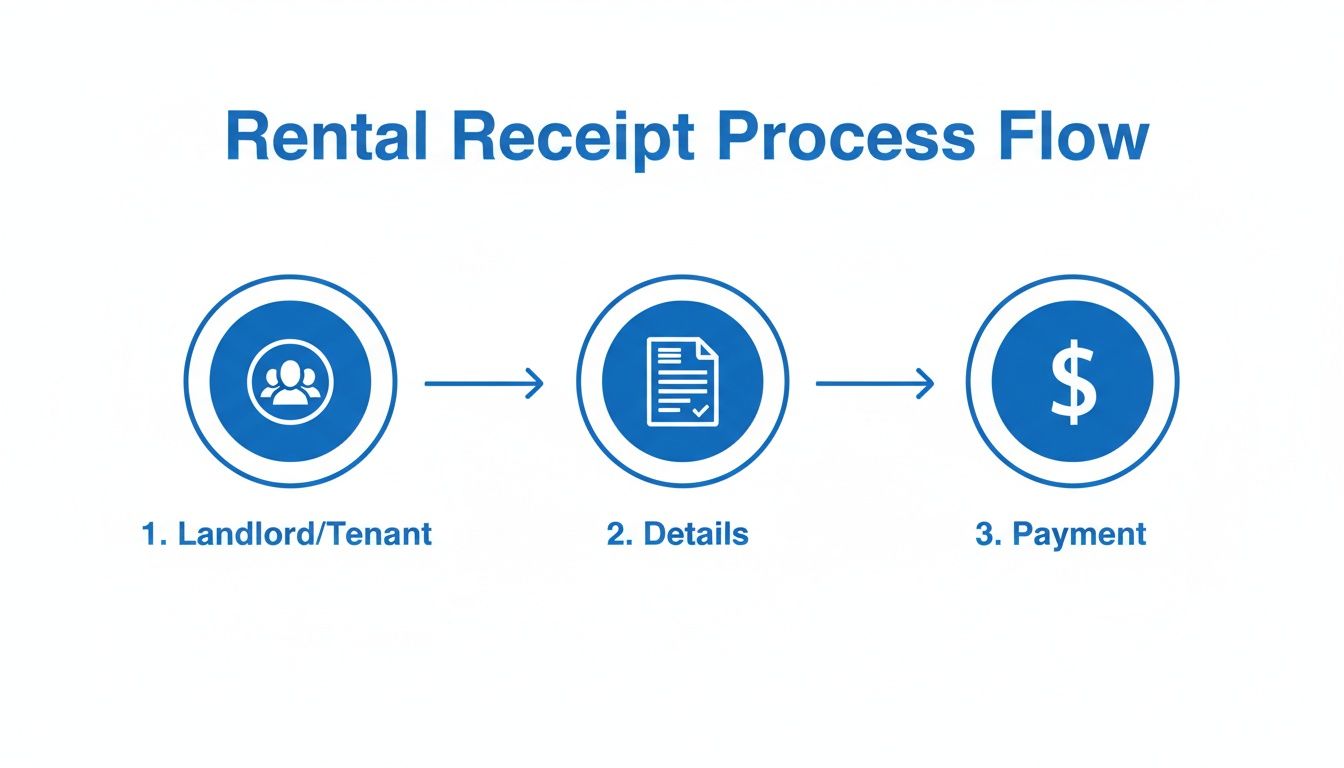
As the diagram shows, it's really just three core stages. This makes professional documentation accessible to anyone, not just large property management firms.
Documenting Modern Payment Methods
The days of relying solely on cash and checks are fading. The global real estate rental market, valued at $2.91 trillion, is increasingly embracing digital payments like ACH, Zelle, and credit cards. Your receipts need to keep pace.
A modern receipt template absolutely must have a field to specify the payment method. Noting that a payment came via "ACH Transfer" instead of "Check #1234" creates a much clearer audit trail for your records. It's a small detail, but it's incredibly important for accurate bookkeeping and can be a lifesaver if you ever need to trace a transaction.
If you're looking for a starting point, you can explore our collection of customizable receipt templates to find a layout that fits your needs.
Pro-Level Tips for Landlords and Property Managers
Having a solid rental receipt template is one thing, but how you use it day-to-day is what really separates the pros from the amateurs. It’s not just about sending a piece of paper (or a PDF). It’s about building a system that’s efficient, transparent, and protects you from potential disputes down the road. You want to shift from just reacting to payments to proactively managing your rental finances.
The key to all of this? Consistency.
Make it a hard-and-fast rule: every time a payment clears, a receipt goes out. I always recommend sending a digital receipt within 24 hours. This small habit does wonders. It puts tenants at ease, shows you’re on top of things, and establishes a professional rhythm they can count on.
Create a Foolproof Digital Filing System
We’ve all been there—scrambling for documents when tax season rolls around. A messy "Receipts" folder on your desktop just won't cut it. You need a clear, logical structure that makes finding any receipt a breeze, even years later.
Here’s a simple but effective way I’ve seen work for countless landlords: organize your files by property, then tenant, then year.
- Top-Level Folder: Property Address (e.g., "123 Main Street")
- Sub-Folder: Tenant Name & Unit (e.g., "Jane Doe - Unit 4B")
- Final Sub-Folder: Year (e.g., "2025 Receipts")
- File Naming Convention: Stick to a consistent format like
YYYY-MM-DD_ReceiptNumber_LastName.pdf. So, a file might look like this:2025-10-05_101_Doe.pdf.
With a system like this, pulling a specific receipt takes seconds, not hours. This is an absolute lifesaver during an audit or if you ever need to review a tenant's complete payment history. For anyone juggling multiple properties, looking into tools for automatic document processing can be a game-changer, saving a ton of time on manual data entry.
Handling Non-Standard Payments with Clarity
Regular monthly rent is easy. The real test of your system is how you handle the exceptions. Your receipt template needs to be flexible enough to document these odd situations with total clarity, leaving zero room for confusion.
Partial Payments: If a tenant only pays part of their rent, your receipt needs to be incredibly specific. I always add a line item that clearly states the "Remaining Balance Due" and the exact amount still owed. This turns the receipt into an official record of what was paid and a subtle reminder of the outstanding debt.
Prorated Rent: When a tenant moves in or out partway through a month, you'll be dealing with prorated rent. Don’t just put a random number on the receipt. Show your work!
- Rent for October 15-31 (17 days): $850
- Note: Prorated at $50/day
This kind of transparency heads off questions before they even come up.
Pro Tip: Never, ever issue a generic "Rent Paid" receipt for a partial payment. Always itemize the amount you received and explicitly state the remaining balance. This is crucial for protecting yourself both financially and legally.
Late Fees and Other Charges: Did the payment include a late fee? List it as its own line item. Don't just lump it in with the rent. This keeps your bookkeeping clean and reinforces the terms of your lease. The same logic applies to security deposit refunds—use the receipt to itemize any deductions for damages before showing the final amount being returned.
By turning these tips into habits, your rental receipt transforms from a simple proof of payment into a powerful tool for communication, record-keeping, and professional management. And if you're more comfortable working in programs you already know, you can check out how to build your own receipt templates in Microsoft Word.
Why Tenants Should Always Ask for a Rent Receipt
Alright, let's flip the script and look at this from the tenant's point of view. A rent receipt isn't just a simple piece of paper or a quick email confirmation. It’s your official, undeniable proof that you've held up your end of the lease agreement.
Think of it as your most important financial shield. If a dispute ever arises, a consistent stack of receipts is your best defense against wrongful eviction claims or misunderstandings about late fees. It's also critical when you move out and need to settle your security deposit. A landlord claiming you missed a payment doesn't have much of an argument when you can pull out a dated receipt for that exact month.
What to Check on Every Single Receipt
Before you file that receipt away, make it a habit to give it a quick once-over. A receipt with the wrong information can be almost as useless as not having one at all.
Here’s a quick pre-filing checklist to run through:
- Correct Amount: Does the total on the receipt perfectly match what you paid? No more, no less.
- Accurate Dates: Check that the payment date (when you handed over the money) and the rental period (e.g., "Rent for October 2025") are both spot-on.
- Your Name and Property: Make sure your name and the full rental address are listed correctly to avoid any mix-ups.
- Payment Method: This is a great habit to get into. If you paid by check, for instance, confirming the check number is noted provides an extra layer of proof.
Taking ten seconds to scan for these details can save you from a world of frustration down the road. If you find a mistake, don't hesitate to ask your landlord for a corrected copy right away.
Building a Positive Rental History
Your collection of rent receipts does more than just protect you—it can actively help you in the future. When you're ready to move and start applying for a new place, most property managers will want to hear from your previous landlords.
A complete file of on-time payment receipts is powerful evidence that you're a reliable and responsible tenant. It's a tangible way to showcase your financial track record, which can make you a much more appealing applicant, especially in a tight rental market.
In an environment where every dollar counts, this proof is non-negotiable. With the U.S. median asking rent recently sitting at $1,696—and still 16.9% higher than it was before the pandemic—a formal receipt is the only real evidence you have that you've met your obligations. You can dig into more current rental market trends on Realtor.com to see why this matters.
The bottom line is simple: always ask for a receipt, even if your landlord doesn't offer one automatically. Whether it’s a digital file or a paper copy from a rental payment receipt template, this document is the foundation of being a smart, protected renter. If you ever need to create your own documentation for any reason, you can always generate a generic business receipt with a simple online tool.
Your Top Rental Receipt Questions, Answered
When you're dealing with rental properties, a few questions about paperwork always seem to pop up. Whether you’re the landlord managing everything or the tenant paying the rent, getting a handle on the details helps keep things smooth and professional for everyone involved.
Let's clear up some of the most common questions we get about rental receipts.
Are Landlords Legally Required to Give a Rent Receipt?
This is the big one, and the short answer is: it depends entirely on where you live.
Rent receipt laws can vary wildly from one state or city to another. Some places have strict rules that require a landlord to provide a receipt for every single payment. Others only make it mandatory if the tenant pays with cash or specifically asks for one.
For instance, places like California and New York have very clear statutes about this, especially for cash payments. But here's the bottom line, regardless of what the law says: always provide a receipt. It's just smart practice. A clear paper trail protects both the landlord and the tenant from headaches and disputes down the road.
My Two Cents: Landlords, don't wait to be asked. Just make it part of your process. Tenants, if you don't get one automatically, always ask. It’s the easiest way to prove you paid and keep the relationship transparent.
What's the Difference Between a Rent Receipt and a Lease Agreement?
It's easy to get these two mixed up, but they play completely different roles.
Think of the lease agreement as the master plan for the entire tenancy. It's the legally binding contract that lays out all the rules of the game: the rent amount, when it's due, what happens if you're late, and who is responsible for what. It covers the whole rental period from start to finish.
A rental payment receipt, on the other hand, is just a confirmation of a single transaction. It’s the proof that a specific payment was made, on a certain date, for a particular month. The lease is the promise; the receipt is the proof you kept it.
How Long Should I Hang On to My Rental Receipts?
For both landlords and tenants, the answer is longer than you might think. A good, safe rule of thumb is to keep all your rental receipts for at least three years after the tenancy has ended.
Here’s why that matters:
- For Landlords: These receipts are your financial records. They're crucial for tax season as proof of rental income, and they are your best defense if a former tenant ever disputes a payment or questions a security deposit deduction.
- For Tenants: Your receipts are your shield. They are the undeniable proof that you paid your rent. If a previous landlord or a credit agency ever claims you owe money months or even years after you've moved out, these little documents can save you a world of trouble.
These days, keeping records is simple. Just scan or save them to a dedicated folder in the cloud. A few seconds of organization can provide years of peace of mind.
Ready to create professional, consistent receipts in just a few clicks? With ReceiptGen, you can build a custom rental payment receipt template in seconds, ensuring your records are always clear and accurate. Try our free receipt maker today at https://receiptgen.com.