
A good taxi receipt template is more than just a piece of paper; it’s a standardized, professional document that lays out all the trip details and fare costs. It replaces messy handwritten notes with clear, credible proof of payment that works for both passengers and drivers. Honestly, it's your ticket to headache-free expense reporting, accurate tax filings, and building real customer trust with every single ride.
Why a Professional Taxi Receipt Is a Non-Negotiable

If you're a serious taxi driver or run a transportation business, it’s time to move past scribbled notes on a scrap of paper. A polished, professional taxi receipt does so much more than confirm a payment—it builds instant credibility and makes the financial side of things simpler for everyone involved.
Think about it from the passenger's perspective. A business traveler needs to expense their ride. If you hand them a flimsy, hard-to-read note, their accounting department might question it, holding up their reimbursement. But a clean, detailed receipt? It sails right through. That small detail reflects well on your service and can be a powerful reason for them to call you next time.
Securing Trust and Simplifying Finances
For you, the driver, a consistent receipting process is the bedrock of good financial management. It gives you an organized, airtight record of your income, which is an absolute lifesaver come tax season. Having clear documentation makes conversations with your tax accountants smoother and keeps your records straight.
This structured approach really pays off. Studies have shown that businesses using systematic receipt documentation can see a 40-60% improvement in the accuracy of their expense tracking. And considering that around 75% of passengers in business-heavy areas ask for receipts to get reimbursed, providing a professional one isn't just a nice touch—it’s a fundamental part of the job.
A standardized taxi receipt template transforms a simple transaction into a professional interaction. It's your best tool for building passenger trust, ensuring accurate financial records, and simplifying the often-complex world of expense reporting and tax compliance.
The Foundation of Professionalism
At the end of the day, a well-designed taxi receipt sends a clear message: you run a serious, trustworthy business. It signals that you care about the details and respect your customers' needs. Before we get into the nuts and bolts of creating one with a tool like ReceiptGen, it's crucial to appreciate what this document really represents. It’s not just about the numbers; it’s a reflection of your brand and a cornerstone of your financial health.
Anatomy of a Perfect Taxi Receipt
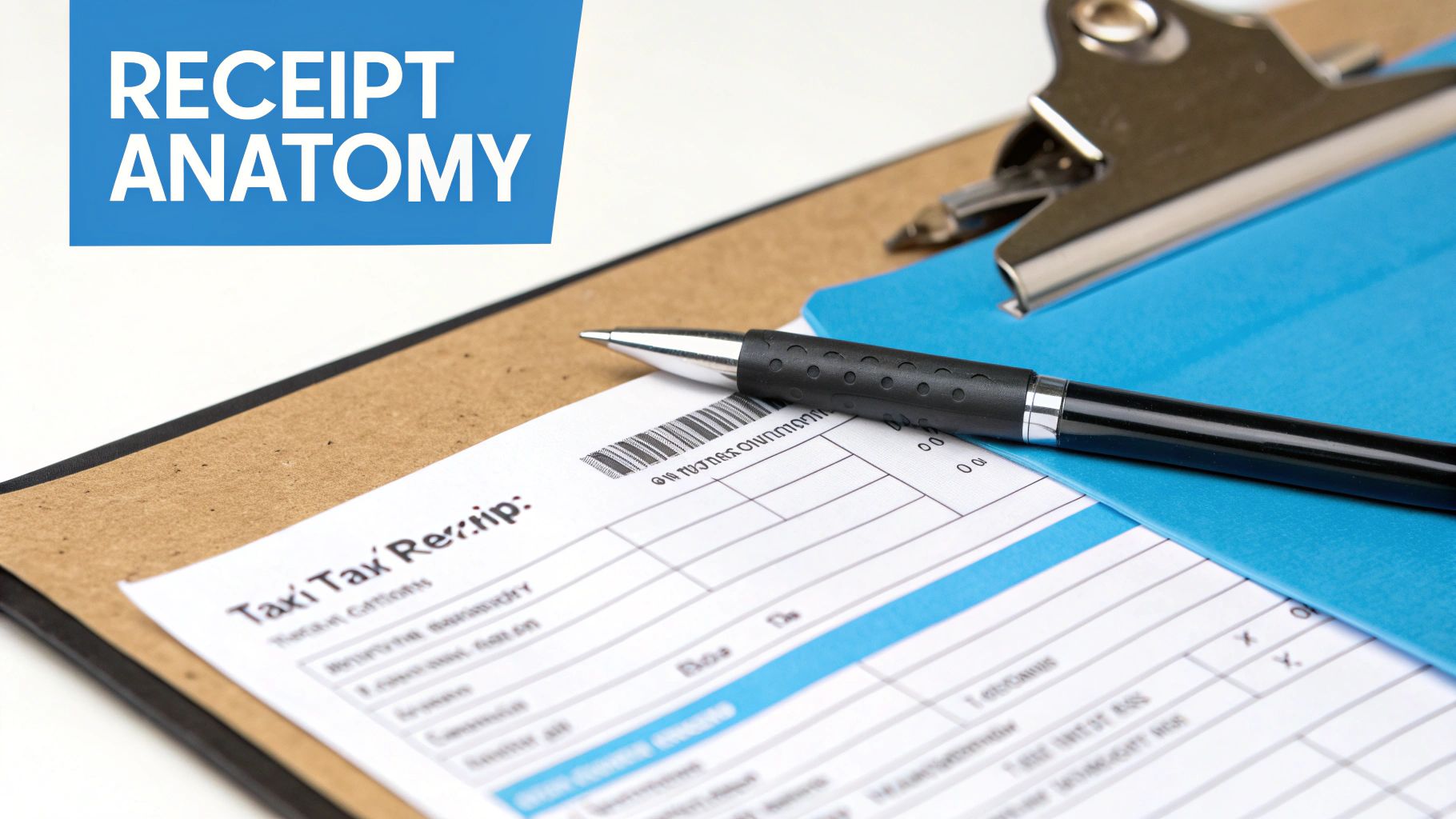
A good taxi receipt does more than just show a total; it tells the complete story of a trip, clearly and logically. Think of it less as a piece of paper and more as a professional document that needs to be legally sound. When you're putting together your template, your goal is to build a blueprint for clarity that leaves no room for questions.
A well-designed receipt anticipates what your passenger—or their accounting department—needs to see. It answers every potential query before it’s even asked, which is what separates a truly professional operation from the rest.
This isn't just about good customer service; it's a critical part of business expense management. In fact, research shows that 60-70% of business travelers claim taxi fares for reimbursement. For them, a clear and complete receipt is non-negotiable. You can dig deeper into business travel expense trends over at TemplateArchive.com.
Identifying the Key Players
Right at the top, your receipt must clearly identify you, the service provider. This is about more than just your name; it's about establishing your legitimacy and giving the passenger a point of contact. This section is all about building trust from the get-go.
Make sure this information is front and center:
- Company or Operator Name: The official name of your business, or your full name if you're an independent driver.
- Driver's Name and License/Permit Number: This is an absolute must-have for compliance and passenger safety.
- Contact Information: A phone number or email address is essential so clients can reach you for future bookings or if they have questions.
Placing these details in the header frames the entire document professionally and makes it instantly clear who provided the service.
Documenting the Journey Details
With the "who" established, the next section needs to cover the "when" and "where" of the trip. These details provide the context for the charges and create an official record of the service. Accuracy here is key, especially for anyone submitting the receipt for reimbursement.
Your template needs dedicated fields for:
- Passenger's Name: While not always mandatory, including it adds a professional touch and is incredibly helpful for corporate clients.
- Date and Time of Trip: Be specific. Include both the start and end times for total transparency.
- Pickup and Drop-off Locations: Don’t just write "downtown." Use specific addresses to create an undeniable record of the route.
This information forms the core of the receipt, justifying the fare breakdown that comes next.
A perfect receipt anticipates the needs of both the passenger and their financial gatekeepers. It provides an itemized, transparent account that leaves no room for doubt, ensuring quick approvals and reinforcing your professionalism.
Breaking Down the Fare and Payment
Now for the part everyone scrutinizes: the money. A single, unexplained total is a red flag for any expense report. An itemized breakdown, on the other hand, builds trust by showing exactly what the passenger paid for. If you want to see great examples of this in action, check out our guide on the itemized receipt template.
Your fare breakdown should have separate, clear lines for:
- Base Fare: The initial flag-drop charge.
- Distance/Time Charges: The cost calculated from the meter.
- Surcharges: Any extra fees, like airport pickups, late-night rates, or charges for extra luggage.
- Tolls: Itemize every toll paid during the trip.
- Tip/Gratuity: A dedicated line for any tip the passenger added.
Finally, you need to confirm the transaction is complete. Clearly state the Total Amount Paid, the Payment Method (Cash, Credit Card, etc.), and if you can, a Transaction ID for card payments. This last step closes the loop, providing concrete proof that the transaction is settled.
Designing a Receipt That Builds Your Brand

Sure, a basic receipt works. But a well-designed one? It’s a tiny billboard for your business, leaving a professional impression that sticks with your passenger long after you've dropped them off. This is your chance to turn a simple taxi receipt template from a forgettable piece of paper into a serious branding asset.
Every single choice, from the logo you use to the font you pick, shapes how people see your service. A crisp, branded receipt shows you care about the details, which builds trust and reinforces that you're running a legitimate operation. It’s a small detail with a big impact on how customers feel about you.
Adding Your Professional Logo
Your logo is your brand's calling card, and it absolutely needs to be on your receipt. Placing it right at the top instantly tells the passenger who the receipt is from and connects the trip directly back to your business.
A few practical tips for getting your logo right:
- Keep it clean: Always use a high-resolution file, like a .PNG or .JPG. A fuzzy, pixelated logo just looks sloppy and unprofessional.
- Size it right: It needs to be big enough to be noticed, but not so huge that it overshadows the fare details. You're aiming for balance.
This one simple addition instantly elevates a generic slip into a custom document that speaks for your business.
Choosing Fonts and Layout for Readability
How you design the receipt affects how easy it is to use. The goal here is clarity. Your passenger should be able to glance at it and find what they need, especially if they're using it for an expense report.
Think clean and simple. Stick to easy-to-read fonts like Arial, Helvetica, or Open Sans. These are go-to choices for a reason—they look great on a screen and on paper, and they don't have any of the distracting flair that comes with fancier, decorative fonts.
A smart layout guides the eye naturally to the most important info. Make the total fare and your company name bold so they jump off the page.
Don't be afraid of white space. Cramming everything together makes a receipt feel cluttered and stressful to look at. Spacing out the key sections—driver info, trip details, fare breakdown—makes the whole thing look more polished and professional. A tool like ReceiptGen makes it easy to drag and drop these elements, save your final design, and make sure every single receipt you issue looks consistently great.
Mastering Digital and Printable Receipt Formats
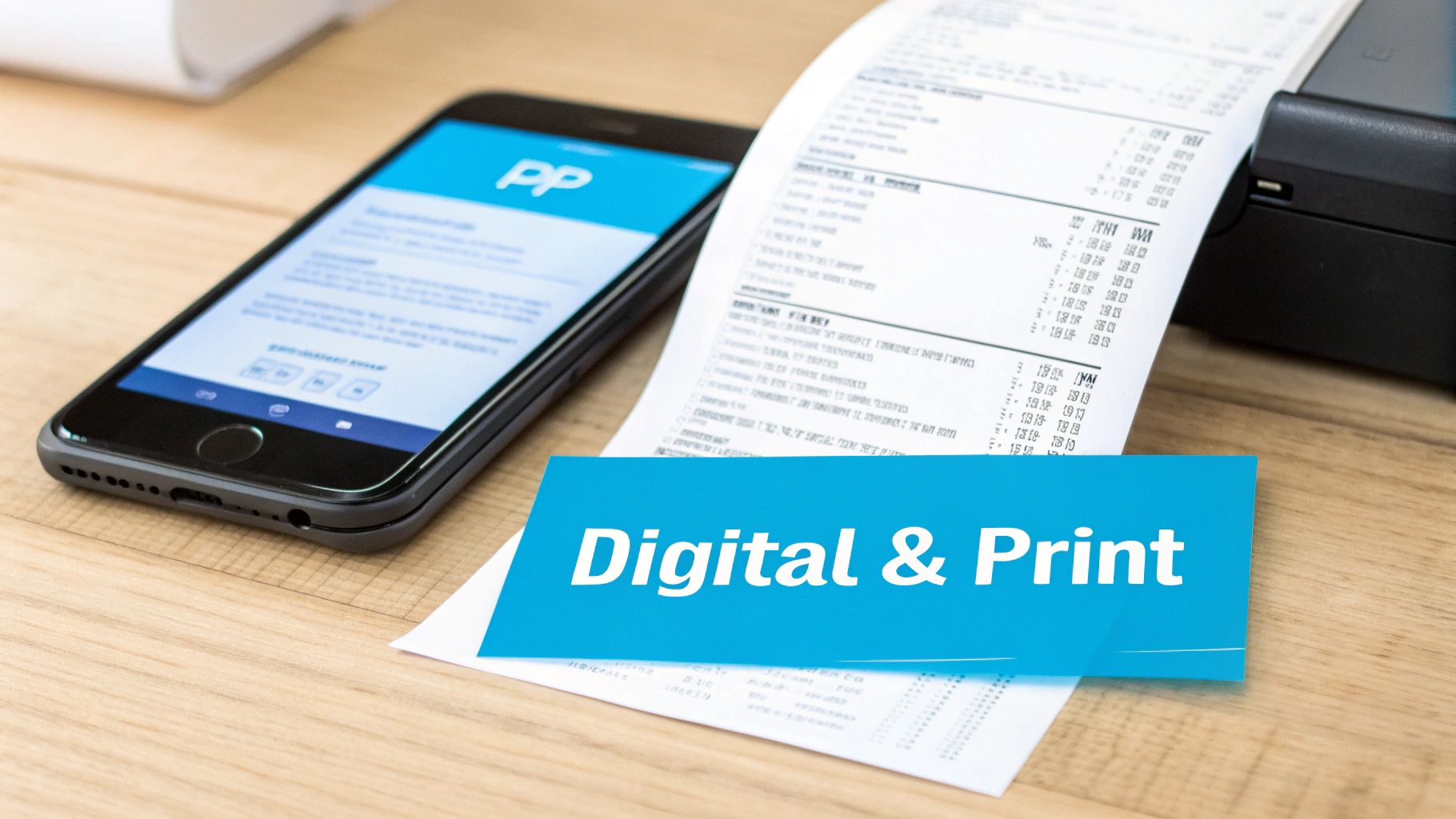
Some passengers live and die by their email inbox, while others want a physical receipt in their hand before they close the door. Offering both isn't just a nice perk; it's a fundamental part of good service. It shows you’re adaptable and prepared for everyone, from the corporate consultant who needs to file expenses digitally to the tourist who just wants a simple paper record of their trip.
You see this split in the numbers, too. In major business hubs, 65-75% of taxi users are traveling for work and rely on digital receipts they can easily forward to their accounting department. Yet, traditional paper receipts are still the norm for 35-45% of taxi services nationwide, especially outside of those tech-heavy city centers.
The Power of the Digital PDF
For speed and pure efficiency, nothing beats a digital PDF. It’s the go-to for business travelers who need to get their expenses filed the moment the trip ends.
Here’s where a digital template really shines:
- Instant Delivery: You can text or email the receipt before the passenger is even out of the car. No more "I think I lost the receipt" phone calls.
- Expense Software Integration: Corporate clients love this. They can upload a PDF directly to platforms like Expensify or Concur without any hassle.
- Eco-Friendly: Less paper means less waste and lower costs for you on ink and receipt books. It’s a small but meaningful way to run a greener operation.
- Perfect Record-Keeping: A digital file is easy for both you and your customer to save and find later, which is a lifesaver come tax time.
When you export from a tool like ReceiptGen, you get a clean, professional-looking PDF that’s ready to go.
When a Printed Receipt Is a Must
For all the talk about going paperless, the classic printed receipt is far from dead. For some people, a physical copy is just what they prefer—or what they absolutely need.
Think about these real-world situations:
- A tourist might not have reliable data or Wi-Fi access on their phone.
- An older passenger may simply be more comfortable with a physical document they can put in their wallet.
- Some company expense policies are still old-school and require employees to tape physical receipts to a form.
If you’re handing out a lot of paper receipts, especially if you need a copy for your own records, looking into services like carbonless forms printing can make your life a lot easier.
Pro Tip: If you're using a portable printer, always check your ink or thermal paper levels. A faded, smudged receipt looks unprofessional and is practically useless for the customer—it creates a problem you were trying to solve.
Ultimately, being ready for both scenarios is key. A flexible template allows you to design one master receipt and then either email it as a sharp PDF or print a hard copy on the spot. This dual capability ensures you can meet any passenger's needs, reinforcing your reputation as a professional who’s prepared for anything. You can also see how these principles apply when you generate a generic business receipt at https://www.receiptgen.com/generate/Generic-Business-Receipt.
Your Quick-Start Guide to Using ReceiptGen
All the theory and best practices we've covered really boil down to one thing: how to create a solid, professional receipt without wasting time. That's where a tool like ReceiptGen comes in. You can take everything we've discussed and build a polished taxi receipt template faster than a typical crosstown fare. It's designed to be dead simple, getting you from zero to a finished document without any fluff.
Instead of wrestling with a word processor every time, the process is much more direct. You just grab a template, pop in the trip details, and hit generate. This completely takes the guesswork out of it and ensures you never forget a key piece of information, which keeps your records straight and your passengers happy.
Getting Started with the Interface
When you first open up ReceiptGen, you'll land right in the editor. It’s built for efficiency. On your left, you have all the fields for your information—the control panel, so to speak. On the right, you get a live preview of the receipt as you build it.
Here’s a look at the main editor, all set for you to enter your business and trip specifics.
That real-time preview is a game-changer. You see every change you make instantly, so you can be sure your logo, fare breakdown, and contact details look exactly right before you finalize anything.
Your first move is to plug in your business details. This means your company name (or your name as the driver), phone number, and address. Think of it as your digital letterhead; you set it up once, and it’s saved for all future receipts.
Next, you'll want to upload your logo. For the best results, use a clean, high-resolution file. I've found that a logo that's at least 200 pixels wide and 200 pixels tall looks sharp on both screens and printed copies.
Customizing Your Taxi Receipt Details
Once your branding is locked in, it's time to fill out the specifics for the actual trip. This is the part you'll do for every ride: passenger's name, date of service, and the pickup and drop-off points.
The itemized fare section is where you really dial in the details. The tool lets you add a separate line for each component of the fare, which is great for transparency.
- Base Fare: Your flat starting fee.
- Mileage/Time: The main charge for the distance or duration.
- Tolls & Surcharges: Any extra fees like airport charges or road tolls.
- Gratuity: A clear, separate line for the tip.
Finally, just choose the payment method—whether it was cash, credit, or debit—and you're done. A single click lets you download a professional PDF to email directly to your passenger or print out.
This simple, repeatable workflow guarantees you'll have a perfect, branded receipt every single time. It's a small touch that goes a long way in reinforcing your professionalism with every passenger. If you want to see what else is possible, you can browse a whole collection of professional receipt templates designed for all sorts of businesses.
Got Questions About Taxi Receipts? We've Got Answers
Even with the perfect template ready to go, you'll still run into questions in your day-to-day operations. Whether you're an independent driver or managing a small fleet, getting the details right keeps you compliant and your passengers happy.
Let's tackle some of the most common questions we hear. Most of them boil down to what's legally required versus what's just good practice. It's a great question—the last thing anyone wants is to hand over a receipt that gets kicked back by a corporate accounting department or doesn't pass muster for tax purposes.
What Legal Information Absolutely Has to Be on a Taxi Receipt?
While the nitty-gritty rules can vary a bit between cities or states, there's a core set of information that every legitimate taxi receipt template needs. Think of these as the non-negotiables that make your receipt official and valid, no matter who's looking at it.
To make sure your receipt is always accepted, you must include:
- Your Business Info: The name of the taxi company or operator and contact details.
- Driver ID: The driver's full name and their official license or permit number.
- The Trip Details: The date, along with the specific pickup and drop-off addresses.
- A Clear Fare Breakdown: An itemized list showing the base fare, mileage or time charges, tolls, and any other surcharges.
- Proof of Payment: The grand total paid and how it was paid (e.g., cash, credit card).
This level of detail is what separates a simple slip of paper from a legitimate business document. It leaves no room for doubt for your passenger's expense report or your own financial records.
Can My Passengers Use a Digital Taxi Receipt for Their Expense Reports?
Yes, absolutely. In fact, digital receipts are now the standard for most companies and tax authorities. They're often preferred over paper copies because they’re much harder to lose and way easier to file and organize.
A PDF you create with a tool like ReceiptGen has all the same crucial information as a paper receipt, making it perfectly fine for any official use. The only thing that matters is that the digital version is complete, accurate, and easy to read.
The modern standard for proof of purchase has definitely shifted. As long as a digital receipt has all the necessary, verifiable information, it carries the same weight as its paper counterpart for virtually all business and tax purposes.
How Do I Create a Reusable Taxi Receipt Template?
Honestly, the most efficient way to keep things consistent and save yourself a headache is to use a dedicated receipt-making tool. Fiddling with a Word doc or a generic template for every single fare is a recipe for mistakes and wasted time.
This is where a platform like ReceiptGen comes in handy. You can design your ideal receipt just once—with your logo, business name, and contact info—and save it as your go-to template. For every new trip, you just pull up the saved design, pop in the new fare and journey details, and generate a clean, professional receipt in seconds. This simple workflow saves you from retyping your own information over and over again and ensures every passenger gets the same polished document.
Ready to create flawless receipts in seconds? With ReceiptGen, you can build, customize, and save your professional taxi receipt template for free. Stop wasting time on manual entry and give your passengers the clear, credible documentation they expect. Try ReceiptGen today and see how easy it is.